
Are you a high-income earner who wants to take advantage of tax-free retirement savings but think you earn too much for a Roth IRA? The Backdoor Roth IRA might be your solution.
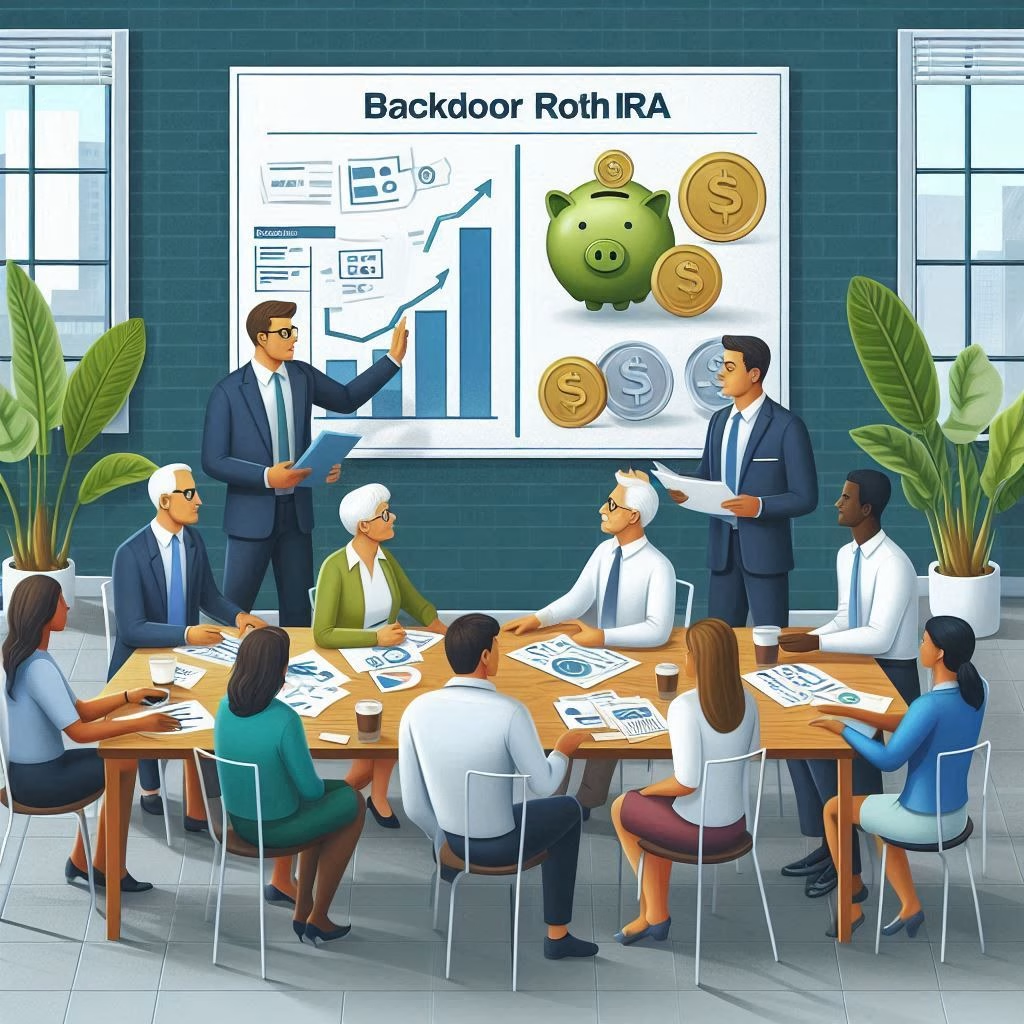
In this guide, I’ll explain:
✅ What a Backdoor Roth IRA is
✅ Who should consider this strategy
✅ Step-by-step instructions on how to execute it
✅ Potential tax pitfalls to avoid
Let’s dive in!
What Is a Backdoor Roth IRA?
A Backdoor Roth IRA is a legal strategy that allows high-income earners (who exceed Roth IRA income limits) to contribute to a Roth IRA indirectly. Here’s how it works:
- Contribute to a Traditional IRA (no income limits).
- Convert the funds to a Roth IRA (since conversions have no income restrictions).
The result? Tax-free growth and withdrawals in retirement!
Who Should Consider a Backdoor Roth IRA?
This strategy is best for:
✔ High earners (above Roth IRA income limits: (150ksingle /236k married in 2025)
✔ Investors who expect to be in a higher tax bracket in retirement
✔ Those who want tax-free withdrawals later
✔ Individuals with no existing pre-tax IRA balances (to avoid the “pro-rata rule”)
Step-by-Step: How to Execute a Backdoor Roth IRA
Step 1: Contribute to a Traditional IRA
- Max contribution: 7,000, or 8,000 if 50+. (2025)
- Since you’re over the income limit for deductions, this contribution is non-deductible.
Step 2: Convert to a Roth IRA
- Contact your brokerage (Fidelity, Vanguard, etc.) and request a Roth conversion.
- The IRS allows unlimited conversions with no income limits.
Step 3: File IRS Form 8606
- Report on the non-deductible contribution (to avoid double taxation).
- Track the conversion for tax purposes.
Key Tax Considerations & Pitfalls
1. The Pro-Rata Rule
If you have other pre-tax IRA funds (e.g., from a rollover 401(k)), the IRS requires you to pay taxes on a proportional basis when converting.
Example:
- You have $50k in a pre-tax IRA.
- You contribute $7k (non-deductible) and convert it.
- IRS treats ~12.3% (7k/57k) as tax-free, the rest is taxable.
Solution:
- Roll pre-tax IRAs into a 401(k) before converting (if allowed).
2. The 5-Year Rule
- To withdraw earnings tax-free, you must wait 5 years after the conversion.
- Contributions (not earnings) can be withdrawn anytime, tax-free.
3. State Taxes
- Some states tax IRA conversions (check local laws).
Backdoor Roth IRA vs. Mega Backdoor Roth 401(k)
| Feature | Backdoor Roth IRA | Mega Backdoor Roth 401(k) |
| Contribution Limit | $7,000 (2025) | Up to $77,000 (2025) |
| Income Limits | None (indirect) | Depends on 401(k) plan |
| Tax Treatment | Tax-free growth | Tax-free growth |
| Best For | High earners without workplace Roth options | Those with employer plans allowing after-tax contributions |
Is a Backdoor Roth IRA Right for You?
✅ Yes, if:
- You max out your 401(k) and want additional tax-free growth.
- You have no existing pre-tax IRA balances (or can roll them into a 401(k)).
- You expect higher taxes in retirement.
❌ No, if:
- You have large pre-tax IRA balances (pro-rata rule makes it costly).
- Your 401(k) doesn’t accept roll-ins to avoid pro-rata taxes.
- You’re in a very high tax bracket now (paying conversion taxes may not be worth it).
Need Help with a Backdoor Roth IRA?
As a financial advisor, I help clients navigate complex retirement strategies like the Backdoor Roth IRA to maximize tax efficiency. 📞 Schedule a free consultation to see if this strategy fits your financial plan!